
Bentonite
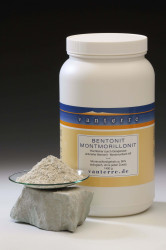
Bentonite - Montmorillonite is a layered clay mineral that was formed by the weathering of volcanic ash over 10 million years ago. Bentonite was named after the first site where it was found, near Fort Benton (USA). However, its extraordinary properties, such as its enormous swelling capacity and adsorption capacity, are determined by the clay mineral montmorillonite it contains. Its name, in turn, comes from the site where it was found, Montmorillon, in southern France. Like zeolite, bentonite has an extremely large specific surface area, which can reach 500 to 800 m². Mathematically, it is actually considerably larger, but let's just call that academic.
Like zeolite clinoptilolite, it is an aluminosilicate and, despite its different structure (it is a layered clay mineral), it ‘works’ like zeolite clinoptilolite as an ion exchanger and molecular sieve with very high adsorption capacity. The ancient Egyptians were already familiar with it and used it in many areas. However, bentonite montmorillonite is still often underestimated. It even has some properties that zeolite does not have. One of the most important is that bentonite montmorillonite, due to its strong swelling capacity as a clay mineral and its huge active surface area, forms a protective gel film on the mucous membranes such as the oral mucosa, oesophagus, gastric mucosa and intestines. This creates a selective protective shield against toxins, heavy metals and other harmful substances, preventing them from entering the bloodstream. The metabolism and the organism are relieved and strengthened. Bentonite montmorillonite also has a very strong mycotoxin adsorption capacity.
Our bentonite is a natural calcium-sodium bentonite with a high proportion (over 90%) of montmorillonite, a hydrated aluminium hydrosilicate. It is hot-ground in a ball mill to a diameter of 10 µm and dried in the process.
In addition, its effect on mycotoxins is even slightly stronger than zeolite. However, as a clay mineral, bentonite also has a small disadvantage. It is not suitable for the impatient. When added to liquids, it needs time to swell. One option is to place it in a sealed container with water so that it can absorb enough liquid and swell at its own pace. This way, you can prepare a large amount for several days. Its potency is retained for a certain amount of time in a sealed container. If you want to use pure bentonite, hold it in a tea strainer over a container and simply stir it through the strainer. This prevents lumps from forming, which then take a long time to swell. :-))
Unfortunately, however, the supply of geogenically activated bentonite from the Aegean Sea was exhausted in 2023, and bentonite of this quality and natural geogenesis could no longer be found anywhere in Europe. After using bentonite from Fort Benton for over a year, which met these criteria, we were still not as satisfied with it as we had been with our previous supply from the Aegean Sea. That is why we searched outside the Aegean Sea and finally found what we were looking for in Sardinia. A bentonite naturally activated by geogenesis, better grinding than in the USA, better silicon-aluminium ratio, more than 90% montmorillonite content and significantly faster swelling. This makes it much easier to handle and much more similar to the original from the Aegean Sea.
Bentonite is heavier than the ultra-fine zeolite clinoptilolite from the air stream. That's why 1400g fits into a 2-litre tin. (In contrast to the 3-litre tin for ‘air stream’ zeolite).
What you should know...
Informations






NATURE - BENTONITE - MONTMORILLONITE 1400g
EUR 42,50
EUR 30,36 pro Kilogramm
incl. 19 % VAT excl. shipping costs